
Choosing Where to Live: Between Campus Convenience and City Life
Studying abroad often feels like a constant negotiation between opportunity and exhaustion. One of the first—and most underestimated—decisions is where to live: close to university for convenience, or further away, closer to the centre, where life feels fuller, louder, and more alive.
The case for living close to university
Living near campus offers a form of structural simplicity that becomes increasingly valuable over time. Short commutes reduce friction in daily life: fewer rushed mornings, less dependency on transport, and more time reclaimed between lectures.
There is also a cognitive benefit. Proximity lowers the threshold for engagement—you are more likely to attend early classes, stay for late seminars, or participate in spontaneous academic opportunities. Over weeks and months, this compounds into stronger academic consistency.
Equally important is energy management. University life is demanding, and eliminating long commutes preserves mental bandwidth, allowing for better focus and more meaningful rest.
However, this choice is not without its limitations. Areas surrounding universities can feel insular, sometimes lacking the cultural richness or vibrancy of the city centre.
The case for living closer to the centre
Choosing to live further from university prioritises experience over efficiency. City centres offer diversity—of people, activities, and atmospheres. Cafés, events, nightlife, and cultural spaces create a dynamic environment that can make everyday life feel expansive.
This option often aligns with a broader vision of studying abroad: not just academic growth, but immersion.
Yet, the trade-offs are tangible. Commutes can become a daily drain—time-consuming, unpredictable, and tiring. Over time, the distance can create a subtle disconnect from university life.
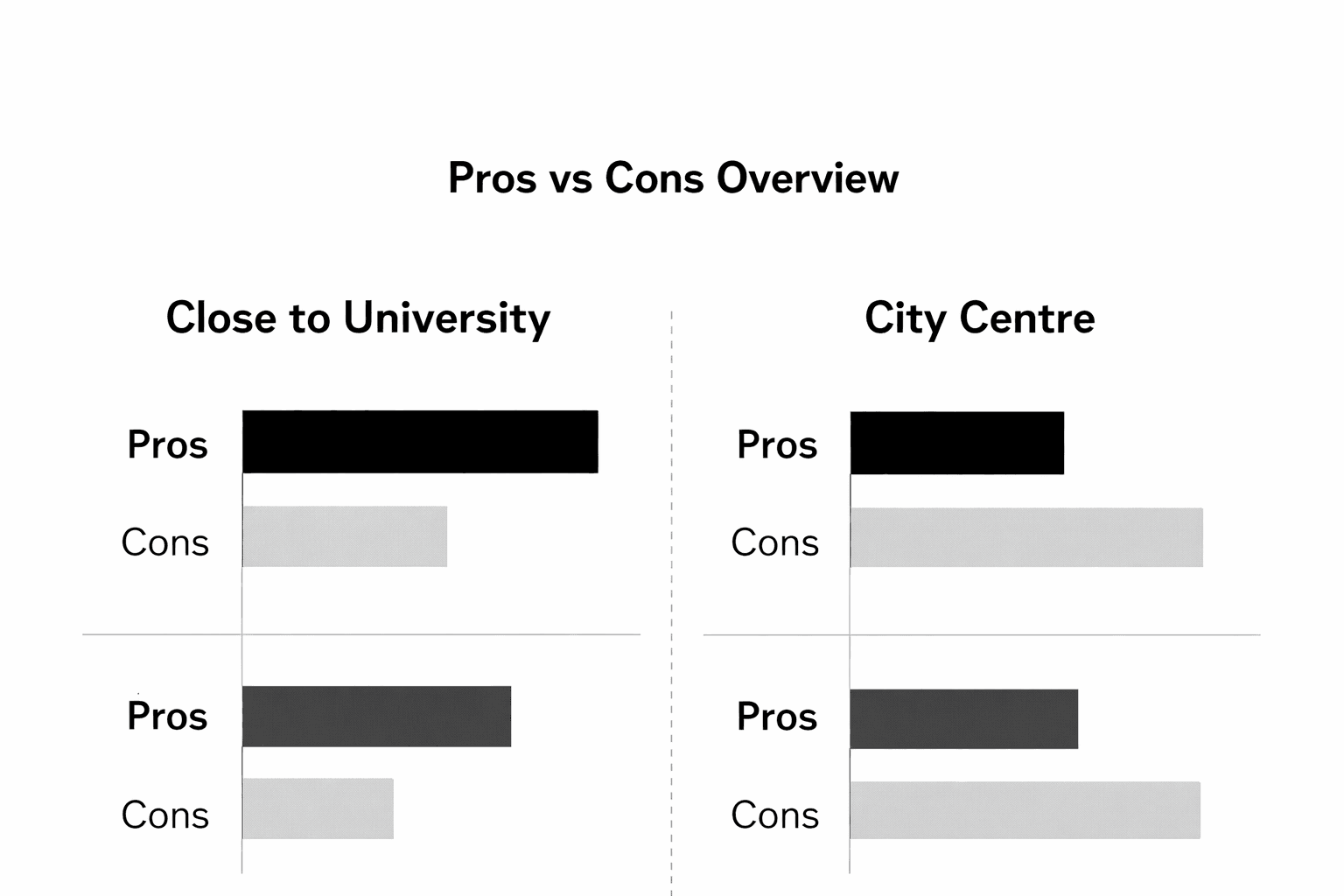
Pros and cons at a glance
| Option | Pros | Cons |
|---|---|---|
| Living close to university | Short commute (saves time and energy) | Less vibrant social/cultural environment |
| Easier attendance and academic consistency | Can feel repetitive or “student bubble” | |
| More time for rest and routines | Fewer spontaneous city experiences | |
| Lower daily stress | Social life may be more limited | |
| Living closer to the centre | Access to nightlife and culture | Longer, tiring commute |
| More diverse social environment | Higher costs (time + transport) | |
| Stronger connection to the city | Risk of reduced academic focus | |
| Greater spontaneity | Fatigue over time |
Final perspective
The decision ultimately reflects a prioritisation: efficiency and stability versus exploration and stimulation. While both paths are valid, living close to university offers a more sustainable balance.
The city remains accessible—but your time and energy are protected. And in the long term, that trade-off tends to matter more than it first appears.